

How Much Clarifier To Add To Pool
 Hullo class, accept your seats – I'm Dr. Pool, and today'south lecture will focus on swimming pool clarifiers.
I'll discuss what puddle clarifiers are made from, when the use of clarifiers is appropriate, and how to avoid a few pitfalls that are particular to using clarifiers in pools.
Let'southward get started, shall we?
Puddle Clarifiers – How do they Work?
Pool clarifiers are polymers that human activity as coagulants on suspended particles in the h2o. Specifically, clarifiers impart cations or positively charged ions to the puddle, which are attracted to negatively charged suspended particles.
 Opposites Attract , and when adding a clarifier to a pool, the positive (+) polymer molecules immediately bond with the negative (-) particles that make pool h2o cloudy. As attraction continues, the particle quickly grows from microscopic size to a larger clump that can be removed past your puddle filter.
An important stardom to make; well-nigh pool clarifiers practice not destroy particulate matter or consume colloidals, they but gather them up in larger and larger clumps, to a size that won't pass through your pool filter. A properly operating pool filter is of paramount importance, to a clarifier's success.
Puddle Clarifiers – What are They?
 The most common blazon of puddle clarifier chemical sold and used is known as a PolyDADMAC, an ammonium chloride with a highly positive charge density. Unlike concentrations of 10% to 40% are useful for virtually any negatively charged colloidal particles.
 Another common and very effective type of puddle clarifier makes use of the natural cations known as Chitosan, or Chitin. Extracted from crab shells, chitosan is bottled in low concentrations of around x% and are ordinarily labeled as a Natural clarifier.
 Some other natural chemical used every bit a puddle clarifier are Enzymes, positively charged particles that actually doeat organic and inorganic colloids, or suspended fabric. Especially useful for oils and organics.
 A group of clarifying agents known as Polyacrylamides, or PAM, makes another fine ionic polymer. For pools, you'll find these packaged in the class of a Gel or Cube. Long lasting and easy to use, merely the gel can clog the fine pores of DE or cartridge filters.
 And there are Aluminum Sulfate products, called merely Alum past those in the know. Alum is used as a flocculant, as information technology tin can clog pool filters. After calculation a Pool Floc production the filter is shut off, to allow the heavy particles to sink to the pool floor, usually overnight. A slow vacuuming to waste the following day will expel the gel-like material, which has the consistency of wet toilet paper.
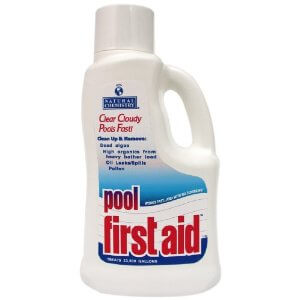 Finally, we have Composite Clarifiers; formulations that contain mixtures of polymer ions, chitosan, enzymes, phosphate removers or sulphates of alum. Multipurpose blends solve several problems at once. These will usually accept higher prices, as they incorporate several pricey ingredients.
When should Pool Clarifiers exist Used?
Pool Clarifiers are not meant to exist used all flavour long, only are quite helpful at pool opening, after an algae blossom, or battles with cloudy pool water.
Follow label directions, but most pools can exist retreated afterward 5-seven days, with a lower dosage than initially used. When clearing turbid h2o conditions, think to proceed your puddle h2o counterbalanced properly and run your puddle filter nearly 24 hours daily.
 Be careful not to overdose pool clarifiers, especially if yous also apply a metallic sequestrant product in your puddle. Also much clarifier in the puddle can act every bit a dispersant instead of a coagulant, compounding your water issues!
Why are Pool Clarifiers Needed?
Information technology'due south not uncommon to have cloudy water upon opening the puddle, or after an algae flower, or every bit a result of reduced filtering or chlorinating – but if y'all need to use clarifier regularly to maintain water quality, information technology could bespeak to other problems. You may have an undersized or worn puddle filter, or ineffective pool sanitation and/or poor water residue.
High pH, depression chlorine , high TDS, high calcium hardness, high alkalinity, high cyanuric acrid – all can lead to cloudy pool water when conditions are right. See my previous post – "l Causes of Cloudy Pool Water" – and you lot can run into there are many, many reasons for turbid pool water.
Poor filtration , poor apportionment, poor sanitation – likewise can lead to poor pool water clarity. It could exist that your pool filter is too small, or that the filter media (sand, cartridge or grids) are in demand of replacement, or perchance you are just not running the filter long enough each 24-hour interval. Filtration needs change throughout the flavour, more is needed during hot weather and active pool use.
Pool Flocculants or Clarifiers?
The terms are sometimes used interchangeably in other industries, but for pond pools and spas, a Flocculant will attract suspended particles to itself, resulting in marble sized clumps that sink slowly to the bottom of the pool. The filter pump remains off during handling, and after eight-12 hours a thick white carpet needs to be slowly vacuumed – to waste.
Clarifiers on the other hand, piece of work with your filter to trap visible and invisible particles floating in the water. Some particles may settle out, but nigh do not become heavy enough to sink. Instead they are drawn into the filter with constant circulation during treatment.
Tips on Using Pool Clarifiers
- Read and follow label instructions exactly, in regards to pool water remainder requirements, correct dosage, application method and pool filtration post-obit treatment.
- Overdosing the pool with polymer clarifiers tin change the accuse of the suspended particles from negative (-) to positive (+), resulting in increased h2o turbidity.
- If pool clarity bug began with an algae bloom, be certain to kill algae before clarifier treatment. This requires 10-30 ppm of chlorine, with a suitably low pH of effectually 7.2.
- Operate the filter 24 hours per day during handling, or as long as possible each day and dark to amend circulation and filtration.
- Resist the urge to over-make clean the filter. Aftermath or make clean the filter only when the force per unit area gauge has risen 7-9 lbs.
- Maintain proper water balance and chlorine levels following handling. Some clarifiers may increment pool pH levels.
See our entire line of pond puddle clarifiers, 20 products to improve puddle water clarity bug by coagulation of suspended particles!
Leave a Reply below if you are having problem with your pool water clarity – I answer them personally!
FEATURED PRODUCTS:

Source: https://blog.intheswim.com/the-ultimate-guide-to-pool-clarifiers/
0 Response to "How Much Clarifier To Add To Pool"
Post a Comment